
Before We Draw the Lines: David Martínez, Jeved, and the Salt River Horses

There is a question near the beginning of David Martínez’s The Maze of History: Komal Hok, O’odham Teachings, and an Earth-Based Sense of Time that has stayed with me:
“What is the meaning of history when a people is not a proponent but a victim of empire building, colonization, assimilation, and progress?” (xxiv)
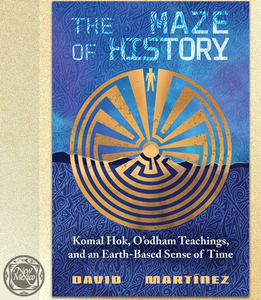
It is a question about history, but also about how we think.
For years, I have argued that understanding the Salt River and its free-roaming wild horses must begin with Akimel O’odham and Piipaash culture, history, and philosophy. I do not mean this simply as a matter of looking into the past. The Akimel O’odham and Piipaash are here now. Their relationships with this land, river, and the other living beings who inhabit it are here now.
Martínez’s book has pushed me to think more deeply about what taking those relationships seriously requires.
Increasingly, I have come to believe that it requires more than adding Indigenous perspectives to a story whose basic categories remain unchanged.
It may require reconsidering the categories themselves.
Himdag, Jeved, and Place
Martínez is O’odham—Akimel O’odham and Hia-Ced O’odham—and enrolled in the Gila River Indian Community. He is a professor of American Indian Studies and Transborder Studies at Arizona State University and director of ASU’s Institute for Transborder Indigenous Nations. Trained as a philosopher and scholar of American Indian Studies, he holds a Ph.D. in philosophy from Stony Brook University and an M.A. in American Indian Studies from the University of Arizona.
One of the things I appreciate most about The Maze of History is that Martínez takes O’odham thought seriously as philosophy. He is not simply describing customs or reconstructing historical practices. He asks how O’odham understand history, place, relationships, and the living world.
Central to that discussion are himdag and jeved.
Martínez describes O’odham himdag as “the accumulative knowledge of the jeved (lands) based on innumerable generations living with what Earth Medicine Maker gave them as their home” (xxi).
Himdag, then, is not simply a collection of traditions or beliefs about land. It is knowledge accumulated through generations of living in relationship with a particular place.
And jeved is not simply “land” in the sense of acreage, property, or territory.
Martínez writes that “every aspect of the jeved is part of the O’odham narrative.” O’odham teachings explain the “interrelatedness of the O’odham jeved and all that dwells within these homelands” and describe relationships among humans, nonhumans, and spirits (xviii).
Later, he explains that Akimel O’odham himdag is concerned with respecting jeved and the akimel—the river—as living beings. It develops an attitude toward jeved that sees “everything as part of the whole” and requires “maintaining healthy kinship ties with land and community, both human and non-human” (80–81).
That word, kinship, matters.
Place, in this understanding, is not merely the physical setting in which history occurs. Relationships among people, land, water, animals, plants, spirits, ancestors, and stories help constitute what the place is.
Martínez makes this especially clear when he writes of Akimel O’odham respect for jeved. It is not simply a belief that particular places contain spirits remembered in stories and ceremonies. It is “knowledge about these lands derived from generations of intimate interactions” (64).
Colonization Changes More Than Ownership
This becomes especially important when Martínez turns to colonization.
“All indigenous peoples bear the scars of their ancestors’ colonization,” he writes (5).
For the O’odham, those scars include enormous changes in their relationship with the land and water that sustained their communities. American settlers occupied lands “they presumed to own by right of conquest,” Martínez writes, while usurping political and economic control from O’odham villages along the Gila and Salt rivers (81).
But colonization did not simply transfer acreage from one owner to another.
“The O’odham himdag has undergone waves of colonization,” Martínez explains, “which O’odham have resisted, adapted to, and (sometimes) been overwhelmed by” (66).
Those responses—resistance, adaptation, and sometimes being overwhelmed—matter.
Indigenous peoples have repeatedly had to survive within political and legal systems they did not create. They have negotiated boundaries, reservations, water rights, governmental relationships, and countless other compromises within those systems.
But accommodation to power should not be mistaken for agreement with the worldview that produced it. Nor should successful adaptation give that system retroactive ethical legitimacy.
Martínez puts the historical problem starkly:
“There is no right of conquest. There is only the historic problem of conquest” (98).
That sentence changes the question.
If conquest does not create an ethical right, then the political geography it produced cannot simply become the unquestioned starting point for every ethical discussion that follows.
Whose Land? Whose Categories?
This is where I think Martínez poses his most difficult challenge.
“One must ask whose land or environment it is before initiating a discourse on environmental ethics” (98).
He then makes an extraordinary observation:
“An environmental ethics on occupied Indian land may require a rethinking of the colonial institutions of border, territory, government, and sovereignty” (98).
Read those categories again:
Border. Territory. Government. Sovereignty.
They are precisely the categories many of us instinctively reach for when trying to resolve conflicts over land.
Where is the boundary?
Whose territory is it?
Which government possesses jurisdiction?
Who exercises sovereignty?
Those are real questions with real legal and political consequences. Martínez is not pretending that contemporary governments or boundaries do not exist.
But he asks whether they should define the ethical universe within which we understand Indigenous relationships with place.
Martínez writes that O’odham were historically rendered “strangers in their own jeved,” forced to exist within “a world not of their own making” (95). An environmental ethics appropriate to that history cannot begin as though the existing distribution of land and authority simply appeared naturally.
It must begin by acknowledging colonization.
Martínez argues that an environmental ethics must recognize that O’odham jeved is occupied and that restoring O’odham land relations—himdag—requires decolonization (98). Elsewhere he is even more direct: “one cannot articulate an Indigenous environmental ethics without first acknowledging that the land is stolen and occupied” (107).
That does not make contemporary legal and political institutions disappear.
It means their existence does not, by itself, establish their moral legitimacy.
Environmental Sovereignty
This brings Martínez to one of the book’s most important concepts: environmental sovereignty.
Martínez argues that O’odham communities must pursue—and non-O’odham people must support as a moral imperative—greater environmental sovereignty over their homelands, particularly sacred places (98–99).
This is more than asking Indigenous communities for opinions about decisions ultimately made by someone else. It concerns creating what Martínez calls the “cultural and political space” in which O’odham people can revitalize himdag (108–109).
For anyone concerned with environmental management, his point is particularly important:
“Discourses on land management, conservation, and ecological restoration must open to an O’odham-centric worldview in which O’odham can exercise their communal values free from outside interference” (109).
An anticolonial environmental ethic, he continues, should enable Indigenous peoples to “recover their original land relations” (109).
That is Martínez’s argument.
What follows is mine.
What Does This Ask of Us?
Martínez does not write about contemporary management of the Salt River free-roaming horses, and I do not want to make him responsible for an argument he does not make.
I want instead to ask what happens when we apply the framework of The Maze of History to a landscape and horse population I have spent years studying.
The historical relationship between O’odham people and horses is well established. In my own research, I corresponded with Justino Balderrama Jr. of the Salt River Pima-Maricopa Indian Community about that relationship. In that correspondence, he told me that O’odham elders describe the horse as “our teacher,” teaching patience, responsibility, trust, and work ethic. He described horses as part of O’odham culture, stories, songs, and ceremonies.
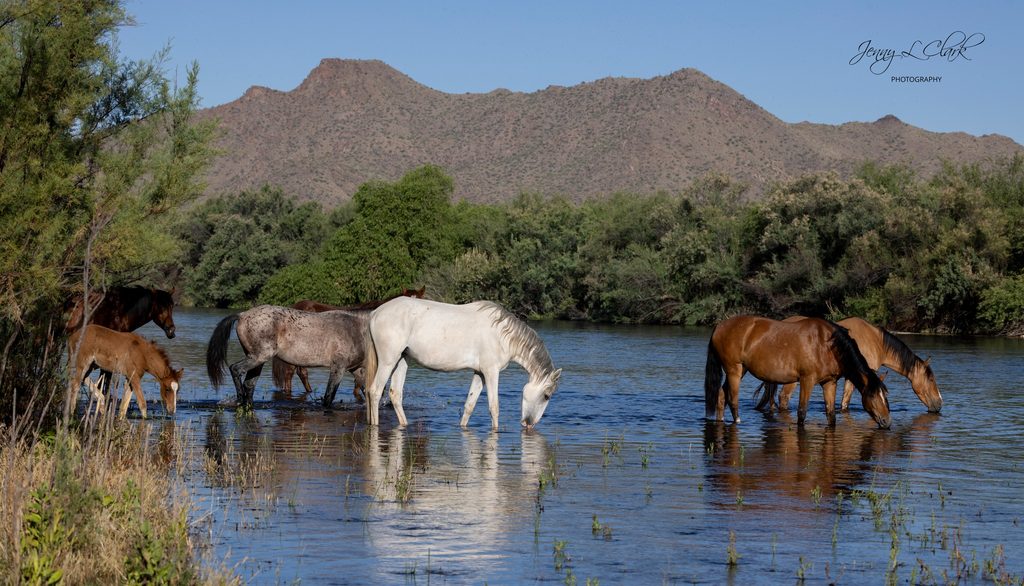
The horses now roaming along the Salt River did not suddenly appear as a population wholly separate from the human communities around them. Their history is intertwined with horses associated with the Reservation and with the larger O’odham landscape.
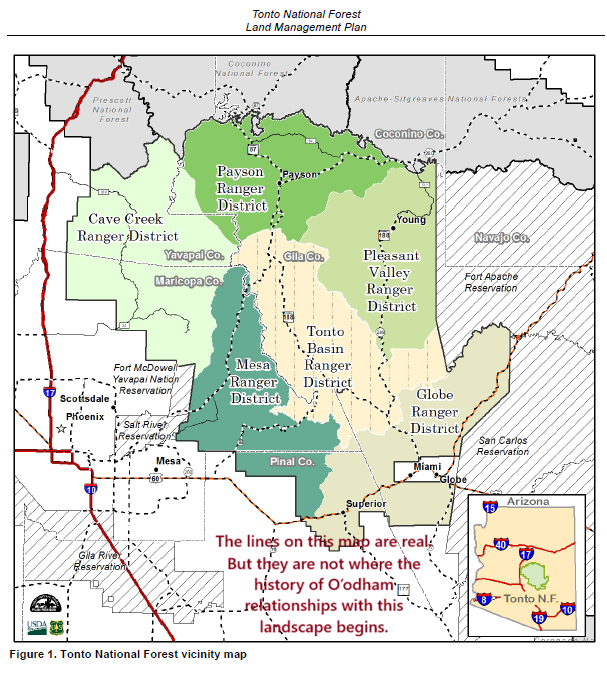
Yet contemporary discussions of those horses almost inevitably begin with a map.
The Reservation ends here.
The Tonto National Forest begins there.
The horses stand on this side of the line rather than that one.
Therefore, we ask which government possesses jurisdiction over the ground beneath their feet.
Those questions are legally important.
But after reading Martínez, I find myself asking whether they are where ethical inquiry should begin.
If horses lived within an O’odham jeved and later crossed a line that became a boundary between Reservation and National Forest, what happened to their relationship with that jeved?
Did the relationship end?
Or did the horses simply cross a political boundary imposed upon an already existing landscape of relationships?
That is not a question Martínez asks about the Salt River horses. It is the question his work leads me to ask.
It raises a larger question I have wrestled with for decades as a historian of Indigenous/non-Indigenous relations in the United States:
Why should a system produced through dispossession be presumed to possess the ethical authority to define the terms on which the consequences of that dispossession are addressed?
The Map Is Real
None of this requires pretending contemporary boundaries do not exist. Nor does it require concluding that every existing boundary must disappear or that centuries of subsequent history can somehow be unwound.
Those are different questions.
The first ethical move is smaller—and more fundamental:
The fact that an arrangement exists does not establish its moral legitimacy.
If generations of Indigenous peoples were forced to negotiate within a political and legal system they did not create, their successful adaptation cannot itself provide that system with retroactive ethical legitimacy.
That is why I remain dissatisfied when discussions of Indigenous relationships with land begin and end with contemporary jurisdiction.
The reservation boundary remains the reservation boundary. The National Forest remains federal land. Governmental entities remain the relevant units. Jurisdiction remains the organizing concept.
Colonization becomes something terrible that happened, while the conceptual geography it produced becomes simply reality.
But what if colonialism did not merely produce injustices within the landscape?
What if it also helped produce the categories through which we understand the landscape?
That question is mine, not Martínez’s. But The Maze of History gives us compelling reasons to ask it.
If the answer is even partly yes, justice cannot consist solely of behaving more fairly within inherited categories. At minimum, we must examine the categories themselves.
Before the Map
Near the conclusion of The Maze of History, Martínez makes an observation that may be the best place to end:
“O’odham do not have a word for ‘world,’ let alone ‘world-view.’ We only have jeved, which refers to land, earth, and soil” (152).
O’odham knew, of course, that other places existed beyond their mountains and rivers. But Martínez explains that those places belonged within the relationships of other peoples. From this emerges what he calls a jeved-centric philosophy of history: a way of understanding people, memories, events, and stories through relationship with place.
That is difficult for those of us formed within a culture of maps, property, jurisdictions, governmental authority, and clearly delineated boundaries. I know it is difficult for me.
Some time ago, I heard an Indigenous scholar make the point in a way I have never forgotten. Speaking about what these places mean to his people, he remarked, approximately, “Once you have been here 10,000 years, then we can talk about what these places mean.”
I no longer hear that simply as a statement about who was here first.
I hear a challenge to consider whether generations of relationship with a place might produce ways of knowing it that cannot be translated neatly into ownership, jurisdiction, and boundary.
And that brings me back to the Salt River horses.
I am not arguing that Martínez tells us what should happen to them. He does not.
I am arguing that he asks us to reconsider where the conversation begins.
Perhaps we should not begin with the line on the map and ask whether an O’odham relationship extends beyond it.
Perhaps we should begin with jeved, with himdag, with the history of the horses, people, river, and other beings among whom they have lived—and then ask what responsibilities follow.
Martínez writes of the moral imperative of greater O’odham environmental sovereignty. He asks whether an environmental ethics on occupied Indigenous land requires rethinking border, territory, government, and sovereignty. And he insists that land-management, conservation, and ecological-restoration conversations must make room for an O’odham-centered understanding of place.
Those are his arguments.
What they require of us at the Salt River is a question we still have to answer.
But surely the first step is being willing to ask it.
The map is real.
It is simply not where the story begins.
Source
David Martínez, The Maze of History: Komal Hok, O’odham Teachings, and an Earth-Based Sense of Time (University of Arizona Press, 2024).