
Costa’s Hummingbird — A True Desert Resident

Sometimes the most remarkable wildlife along the Salt River comes in the smallest packages.
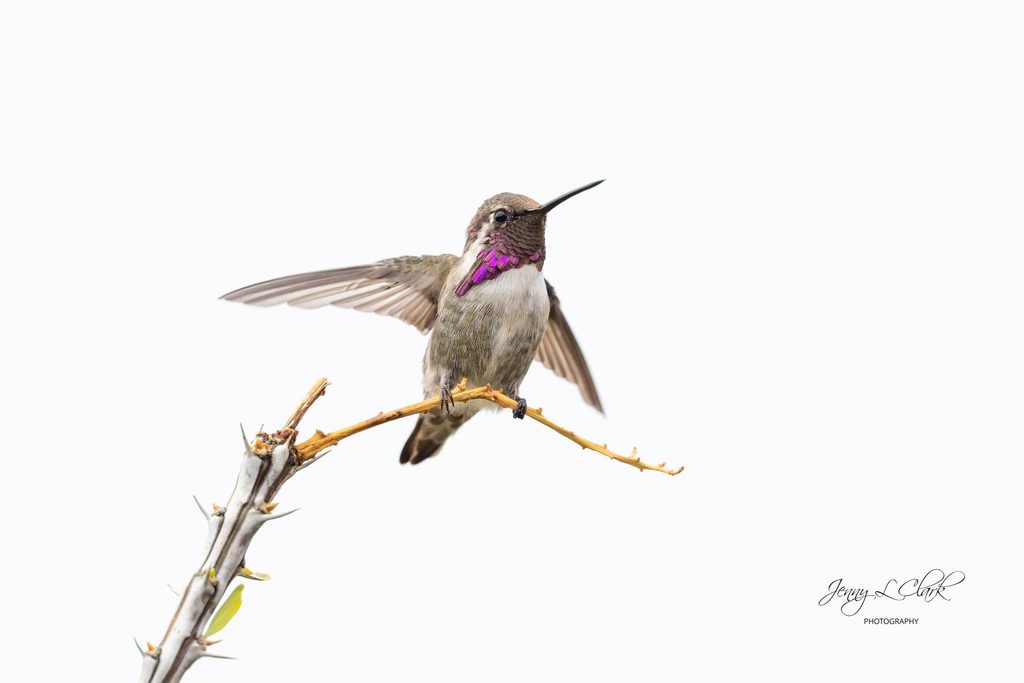
The Costa’s hummingbird (Calypte costae) is one of the Sonoran Desert’s most extraordinary birds. Measuring only about three to three and a half inches long, it is easy to overlook—until a male turns his head toward the sunlight and suddenly flashes a brilliant violet-purple crown and throat.
Those spectacular feathers, which extend down the sides of his throat like purple streamers, make the Costa’s one of the most distinctive hummingbirds in the Southwest.
But there is much more to this tiny bird than its remarkable colors.
🧭 Behavior, Habitat, and Natural History
The Costa’s hummingbird is a desert specialist, closely associated with the Sonoran and Mojave deserts. Many breed in desert scrub during late winter and spring, when flowering plants provide abundant nectar, then move to coastal or other flower-rich habitats as desert nectar becomes scarce.
Long before modern development transformed the Salt River, hummingbirds were part of the ancestral homeland of the Akimel O’odham. The hummingbird holds a meaningful place in O’odham traditions concerning relationships between people, other living beings, and their homeland, O’odham jeved.
💡 Fun Fact 1 — The Sonoran Desert Hummingbird
The Costa’s is sometimes called a true desert hummingbird, and for good reason. Unlike many hummingbirds that pass through the Sonoran Desert during migration, Costa’s hummingbirds are year-round residents in suitable portions of the desert. They can nest during the cooler months, taking advantage of winter rains and the flowering plants that follow.
💡 Fun Fact 2 — Purple Without Purple Pigment
The male’s brilliant violet-purple throat feathers get their color largely from microscopic structures that reflect light rather than from purple pigment. Depending on the angle of the sunlight, those same feathers can appear dazzling purple or nearly black.
💡 Fun Fact 3 — Surviving the Desert Night
Costa’s hummingbirds can enter a state called torpor, dramatically slowing their metabolism and lowering their body temperature to conserve energy. For a bird that weighs only a few grams and must consume tremendous amounts of energy relative to its size, this adaptation can make the difference between surviving a cold night and exhausting its energy reserves.
🌍 Why It Matters
When we watch a Costa’s hummingbird feeding along the Salt River, we are witnessing something that connects us to a much older history. Long before Europeans arrived, before modern dams and roads, hummingbirds were part of a landscape known to generations of Akimel O’odham. Although the wild horses arrived later, they too are part of the river’s unfolding story.
Together, they remind us that the Salt River is not a landscape frozen in time. It is a place shaped by thousands of years of relationships between people, animals, water, and land.
Different histories. One living landscape.